Articulate Storyline 360
Strategic and Ethical use of AI-Tools for School Teachers
Course Access Note
This project is presented in multiple formats to support different review preferences.
-
Live Course Link: This course is hosted on SCORM Cloud to provide the full interactive experience (including audio and downloadable resources). You may be asked to enter a name and email to launch the module (any email and initials can be used i.e. hsohony02@gmail.com; H.S.)
-
Video Walkthrough: A video showcasing the complete course flow, user interactions, decision points, and the overall learner experience.
-
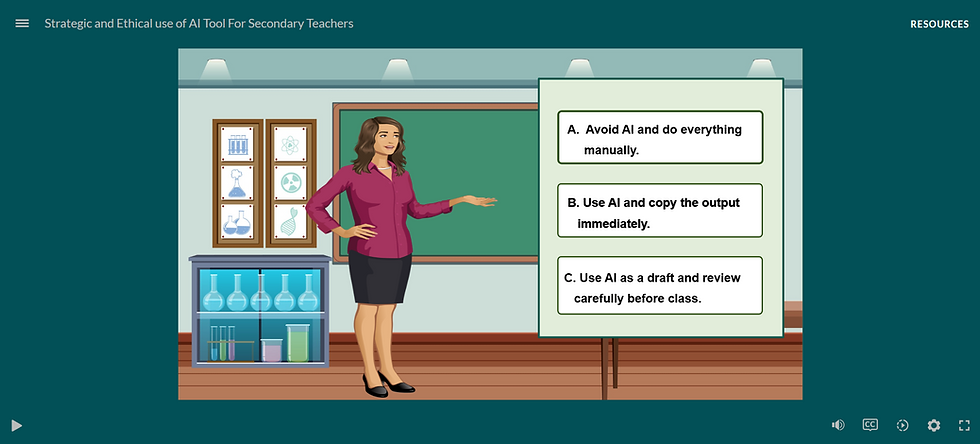
View image Gallery: Browse screens for a quick overview of the course design.
On this Page
This project is a conceptual case study demonstrating my instructional design process from research to evaluation. This page has divided into two main sections a brief overview>
Video Walkthrough
Project Image Gallery


The Problem
Secondary teachers spend significant time on planning, assessment, and grading, yet often lack structured ways to integrate AI into their workflow, limiting its potential to reduce workload and enhance productivity.
The Solution
To address this gap, a scenario-based interactive professional development module was developed using Articulate Storyline 360. The module provides structured guidance on the strategic and ethical use of AI for lesson planning, activity design, and assessment support.
Through realistic classroom scenarios, ethical checkpoints, and guided practice, it enables teachers to integrate AI effectively by reducing workload and improving productivity while maintaining instructional quality.
The Outcome
The module enables teachers to apply AI tools more confidently and strategically in their daily workflow. By providing scenario-based interactive activities and practice, while connecting it to real classroom tasks, it supports more efficient lesson planning, assessment design, and classroom preparation, while promoting responsible and ethical AI use.
Project Brief Overview
Phase 1: Learner Research
Focused on understanding learner needs, context, and challenges to inform effective instructional design decisions.
-
Conducted interviews & observations.
-
Analyzed Learner's prior knowledge.
-
Identified AI awareness, motivations and challenges.
-
Considered stakeholders and teachers concerns
-
Developed Empathy Map and Personas (view) for two different age groups.
-
Derived instructional design Implications based on learner personas.
-
Defined the Problem Statement.
Phase 2: Analysis & Design
Focused on defining the learning strategy, aligning objectives, and designing an effective instructional approach.
-
Defined role and responsibilities as learning Experience designer.
-
Clearly defining learning goals and objectives.
-
Considered backward design approch to align assessment and learning objectives
-
Exploring solutions using divergent and convergent thinking for assessment design and lesson planning.
-
Selecting appropriate instructional strategies and learning theories based
on learner needs and make connection to real world examples.
-
Selecting the primary learning platform.
-
Defining the solution and outcome.
Phase 5- Evaluation and Revision
Focused on analyzing feedback and continuously improving the learning experience.
-
Identified key findings and areas for improvement
-
Evaluated learner feedback (reaction)
-
Assessed learning outcomes (knowledge and skill acquisition)
-
Analyzed impact on performance and effectiveness
-
Developed a continuous improvement plan
Project in Detail
Phase 1 - Learner's Research
The target learners are:
The target learners are secondary/school teachers participating in professional development. They are experienced educators with strong subject knowledge but face time constraints and increasing demands for efficiency in planning and assessment.
Learner’s Prior Knowledge and Skills:
-
Strong foundation in lesson planning and classroom management
-
Familiar with curriculum alignment and differentiation
-
Experience with formative assessment strategies
-
Basic understanding of instructional design principles
Technological Knowledge:
-
Basic to intermediate digital literacy
-
Regular use of LMS platforms and presentation tools
-
Familiar with online resources and assessment systems
-
Comfortable integrating technology into teaching
AI Awareness:
-
Basic awareness of AI tools
-
Limited experience (mainly idea generation)
-
Lack of structured application in teaching tasks
-
Uncertainty around ethical use and reliability
Motivation & Interests:
-
Improve instructional effectiveness
-
Save time in lesson planning
-
Increase productivity
-
Explore practical digital tools
-
Seek career growth and professional development
Learner Characteristics:
-
Self-directed and problem-oriented (adult learners)
-
Prefer practical, ready-to-use strategies
-
Value step-by-step guidance
-
Varying levels of digital confidence
Stakeholders and Teachers’ Concerns:
-
Schools teachers (Primary learners)
-
School administrators
-
Academic coordinators.
Teachers’ Key Concerns:
-
Limited time due to planning, grading, and admin tasks
-
Need for efficiency without compromising quality
-
Concerns about AI reliability and ethical use
-
Varying levels of digital confidence
-
Lack of structured framework for AI integration
Empathy Map & Persona


Defining the Problem Statement
Secondary teachers spend significant time on lesson planning, activity creation, and assessment design. While many are aware of AI tools and use them occasionally, their application remains unstructured and lacks clear ethical and strategic direction.
As a result, AI is not effectively leveraged to improve teaching efficiency.
There is a need for a focused professional development module that equips teachers with practical, ethical, and structured strategies to integrate AI into daily classroom tasks.
Role & Design Approach
As the instructional designer and course developer, I designed a focused, practical professional development module addressing teachers’ workload challenges while aligning with stakeholder expectations for ethical and effective AI integration.
The module is grounded in adult learning principles and relevant learning theories, ensuring a problem-centered, experience-based, and immediately applicable learning experience. It applies andragogy, experiential learning, and constructivist approaches to promote active engagement, real classroom scenarios, and guided practice for meaningful transfer into teaching practice.
The design emphasizes time efficiency, practical application, and confidence-building, enabling teachers to reduce workload without compromising instructional quality. It also incorporates formative assessments, including scenario-based tasks, guided AI application exercises, and reflective checkpoints to support continuous learning and monitor understanding.
Phase 2: Analysis & Design
Focused on defining the learning strategy, aligning objectives, and designing an effective instructional approach.
Design Foundation:
The module is grounded in adult learning principles and aligned with backward design methodology to ensure relevance, alignment, and practical application.
-
Learner-centered and problem-oriented approach
-
Focus on real classroom challenges
-
Emphasis on immediate application and efficiency
-
Designed for experienced adult learners with time constraints
Application of Andragogy (Knowles):
The design incorporates Knowles’ principles of adult learning:
-
Need to Know - Highlights workload challenges and relevance of AI
-
Self-Concept - Scenario-based decisions promoting autonomy
-
Prior Experience - Activities connected to teachers’ real contexts
-
Readiness to Learn - Focus on daily classroom tasks
-
Problem-Centered Orientation - Solving real teaching challenges
-
Internal Motivation - Emphasis on efficiency and professional growth
Learning Theories Applied: To support effective learning, the module integrates:
-
Constructivism - Learning through active engagement and real-world scenarios
-
Experiential Learning -Learn → Reflect → Apply cycle
-
Cognitive Load Theory - Simplified structure to reduce overload
Instructional Design Principles:
-
Clarity & Simplicity- Avoid overload of tools or theory
-
Scaffolding - Awareness → guided practice → independent application
-
Alignment -Activities directly support learning objectives
-
Relevance - Real classroom application
-
Immediate Application -Usable strategies post-training
Backward Design Approach:
The module follows a backward design framework:
-
Define Desired Results- Teachers apply AI effectively in classroom tasks
-
Determine Evidence- Scenario-based tasks, prompt-building, output evaluation
-
Plan Learning Experiences- Guided practice and real-world application
Learning Goals & Objectives:
Learning Goal: Enable teachers to use AI strategically and ethically to improve classroom efficiency.
Learning Objectives:
-
Apply the S.A.V.E. workflow to evaluate AI use in classroom scenarios.
-
Construct structured prompts using the RGRO framework.
-
Evaluate AI-generated outputs using an ethical checklist before classroom use.
Assessment Strategy:
-
Scenario-based decision-making tasks
-
Prompt construction exercises
-
AI output evaluation using ethical checklist
-
Final applied classroom task
Delivery Approach:
-
Online, asynchronous module
-
Self-paced learning
-
Designed for varying digital confidence levels
Proposing the Solution
To address this gap, a scenario-based interactive professional development module was designed using Articulate Storyline 360. The module provides step-by-step guidance on the strategic and ethical use of AI for lesson planning, activity creation, and assessment support.
Through realistic classroom scenarios, built-in ethical checkpoints, and guided practice activities, the solution enables teachers to integrate AI effectively into their daily workflows reducing workload and improving productivity while maintaining instructional quality.
Phase 3: Development
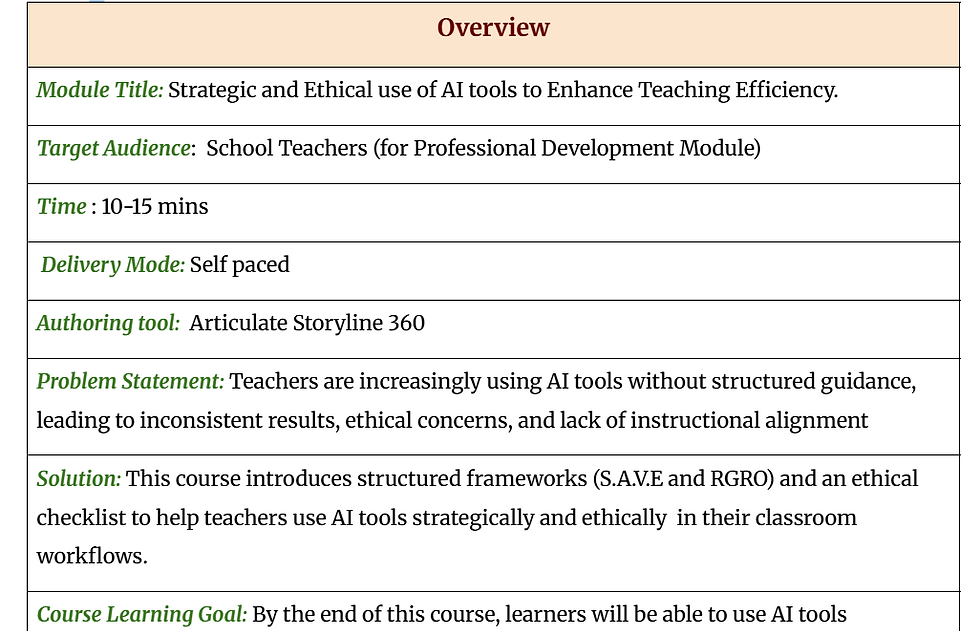
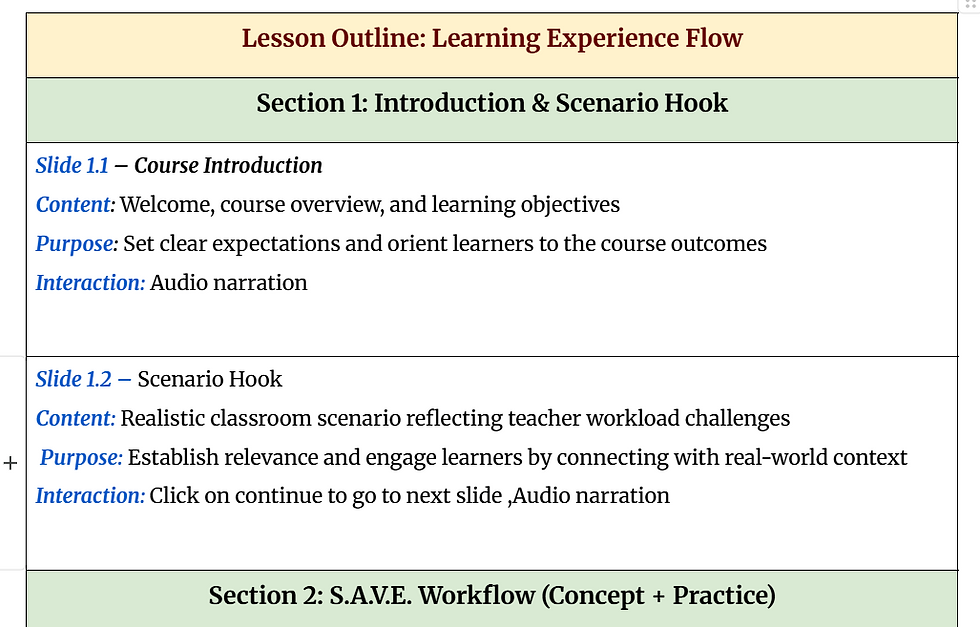
Lesson Outline

Story Board


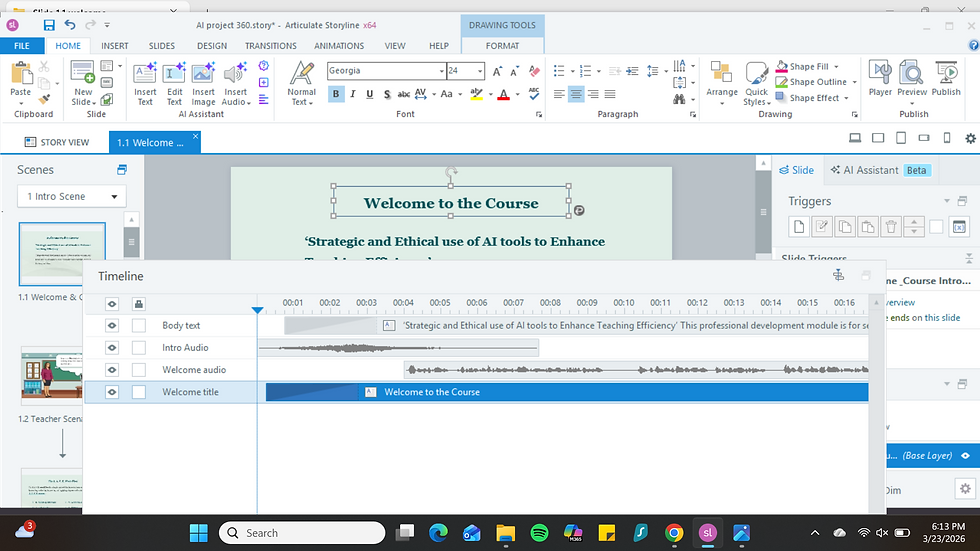
Authoring view


Mock up slides
Phase 4- Implementation
Module Delivery:
The module is designed as a 15–20 minute asynchronous, self-paced eLearning experience developed using Articulate Storyline 360. It is intended to be hosted on a Learning Management System (LMS) and accessed by secondary teachers during professional development time.
Rationale for asynchronous delivery:
-
Provides flexibility for teachers managing busy schedules
-
Supports self-paced learning
-
Accommodates varying levels of digital confidence
-
Enables immediate, on-demand access to learning
-
Flexible completion window to complete the module
Planned Pilot Testing & Iteration (Proposed):
To ensure effectiveness and usability, the module undergoes a two-stage testing and one technical testing process before full implementation.
Stage 1 - Internal Review (Alpha Testing)
-
Participants (Proposed):
-
1–2 instructional design peers
-
1 subject-matter expert (experienced secondary teacher)
-
-
Focus areas:
-
Content accuracy
-
Alignment with learning objectives
-
Clarity of instructions
-
Technical functionality (triggers, navigation, feedback)
-
Accessibility compliance
-
Revisions will be made based on feedback.
-
-
Outcome:
-
Feedback would be used to refine content clarity, improve alignment, and address usability issues.
-
Stage 2- Small Group Pilot (Beta Testing)
-
Participants (Proposed):
-
5–8 secondary teachers representing varied experience levels
-
-
Data to be collected:
-
Time required to complete the module
-
Areas of confusion or difficulty
-
Perceived relevance to classroom practice
-
Ease of navigation and interaction
-
Confidence levels before and after training
-
-
Outcome:
-
Feedback would be gathered through a post-module survey and optional open-ended responses, informing further refinements.
-
3.Technical Validation (Planned)
-
LMS compatibility (SCORM compliance)
-
Browser functionality (Chrome, Edge, Safari)
-
Mobile responsiveness (if applicable)
-
Accessibility (keyboard navigation, screen reader compatibility, contrast checks)
-
Outcome: Any identified issues would be resolved prior to final deployment.
Phase 5- Evaluation and Revision
Evaluation focuses on measuring learning effectiveness, real-world application, and impact on teaching efficiency. As this is a conceptual case study, the following outlines the planned evaluation strategy.
Evaluation Framework (Planned)
Level 1: Reaction (Immediate Feedback)
-
Purpose: Measure participant satisfaction and perceived relevance.
-
Method: Post-module survey including:
-
Relevance to classroom tasks (Likert scale)
-
Clarity and practicality of AI workflows
-
Confidence in using AI strategically
-
Level 2: Learning (Knowledge & Skill Acquisition)
-
Purpose: Assess achievement of learning objectives
-
Evidence Sources:
-
Performance in interactive activities
-
Completion of prompt-building tasks
-
Accuracy in applying the ethical checklist
-
Final application task
-
-
LMS Tracking (proposed):
-
Completion rates
-
Assessment scores
-
Attempts and retries
-
Level 3: Behavior (Transfer to Practice) (Proposed)
-
Purpose: Evaluate application of learning in real classroom settings
-
Method (2–4 weeks post-training):
-
Follow-up survey assessing:
-
Have you used AI for lesson planning since completing the module?
-
Which tasks have you applied AI to?
-
Approximately how much preparation time has been reduced?
-
What challenges remain?
-
Optional: Voluntary submission of one AI-supported lesson example
-
This measures real-world transfer of learning.
-
-
Level 4: Results (Impact on Efficiency)
-
Purpose: Measure broader performance impact.
-
Potential Indicators:
-
Self-reported reduction in planning time
-
Increased use of structured prompts
-
Increased teacher confidence in ethical AI use
-
Positive feedback from academic coordinators
-
In a small-scale implementation, qualitative insights would provide meaningful indicators of impact.
-
Data Collection Methods (Proposed):
-
Pre-module self-assessment (confidence in AI use)
-
Post-module survey (confidence, clarity, perceived usefulness)
-
LMS analytics (completion, interaction success, time spent)
-
Follow-up survey (application and impact)
-
-
Continuous Improvement Plan (Proposed)
-
Based on collected insights, the module is designed to be iteratively improved
-
Revise unclear instructions
-
Improve prompt examples
-
Simplify interactions if needed
-
Refine ethical checklist based on common challenges
-
Add optional advanced resources
-
-
-
The module would be continuously updated to better align with learner needs and stakeholder expectations.