Canvas LMS
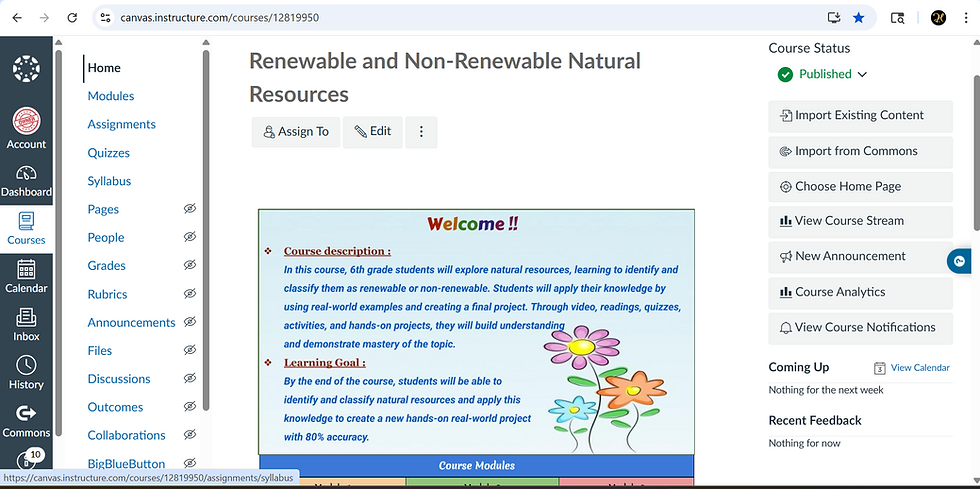
An interactive and engaging eLearning module for 6th-grade learners
Course Access Note
This project is presented in multiple formats to support different review preferences.
-
Live Course Link: Access the course in Canvas LMS and experience the full learning flow.
-
Video Walkthrough: A video showcasing of the complete course flow, user interactions,
decision points, and the overall learner experience.
-
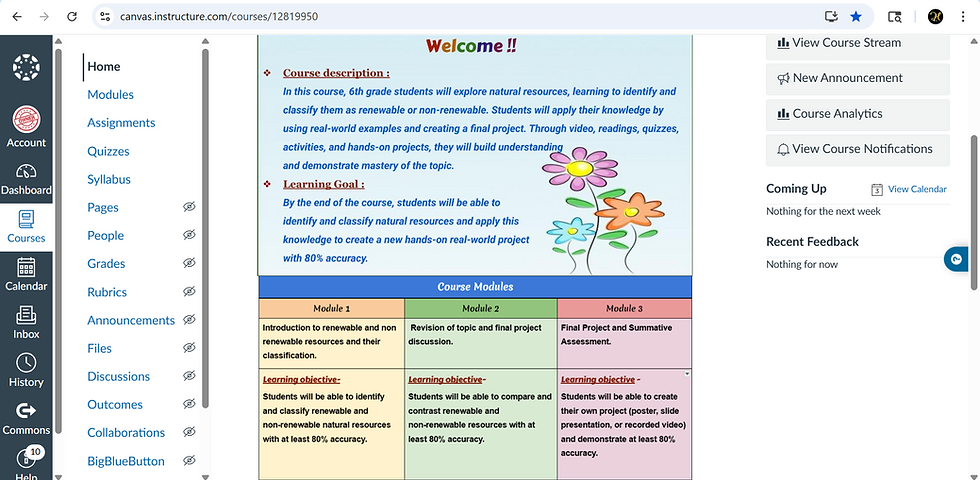
View image Gallery: Browse screens for a quick overview of the course design.
Live Course Link & Login
-
Canvas Link- https://canvas.instructure.com/courses/12819950
-
Student login email- galka9711@gmail.com
-
Password-Testuser#123
On this Page
This page has divided into two main sections a brief overview> and a project detailed section>
Video Walkthrough
Project Image Gallery

The Problem
At a Middle School, only 16% of 6th graders demonstrate proficiency in classifying renewable and non-renewable resources. This knowledge gap makes it difficult for students to engage in more complex environmental topics later in the unit.
The Solution
To address the learning gap, an engaging eLearning module was developed using existing Canvas LMS features. The course integrates interactive content, collaboration, guided practice, formative assessments, and timely feedback. By leveraging familiar tools and brief tutorials without introducing new technologies the solution ensures effective instruction within practical constraints.
The Outcome
This eLearning solution creates an engaging, learner-centered experience that improves students’ ability to classify renewable and non-renewable resources while strengthening both understanding and application.
-
Increased learner engagement through interactive, feedback-driven activities.
-
Improved conceptual understanding and real-world application.
-
Effectively addressed identified learning gaps.
-
Built a foundation for advanced environmental science learning.
-
Designed for accessibility, scalability, and ease of implementation.
Project Brief Overview
Phase 1: Learner Research & Analysis
Focused on understanding learner needs, prior knowledge, and learning challenges to inform effective instructional design decisions.
-
Conducted learner interviews and classroom observations.
-
Analyzed prior knowledge and identified learning gaps.
-
Identified learner needs, motivation, and challenges.
-
Considered teacher and stakeholder perspectives.
-
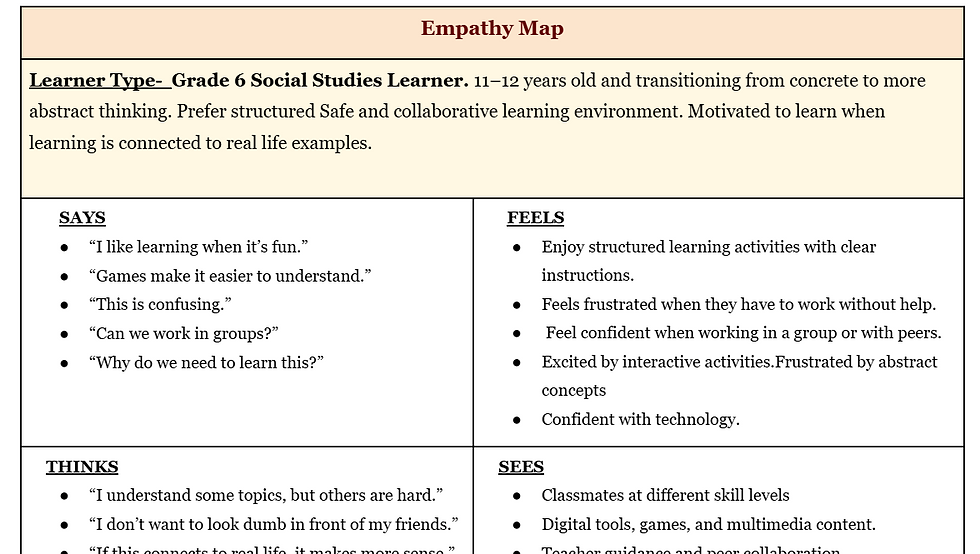
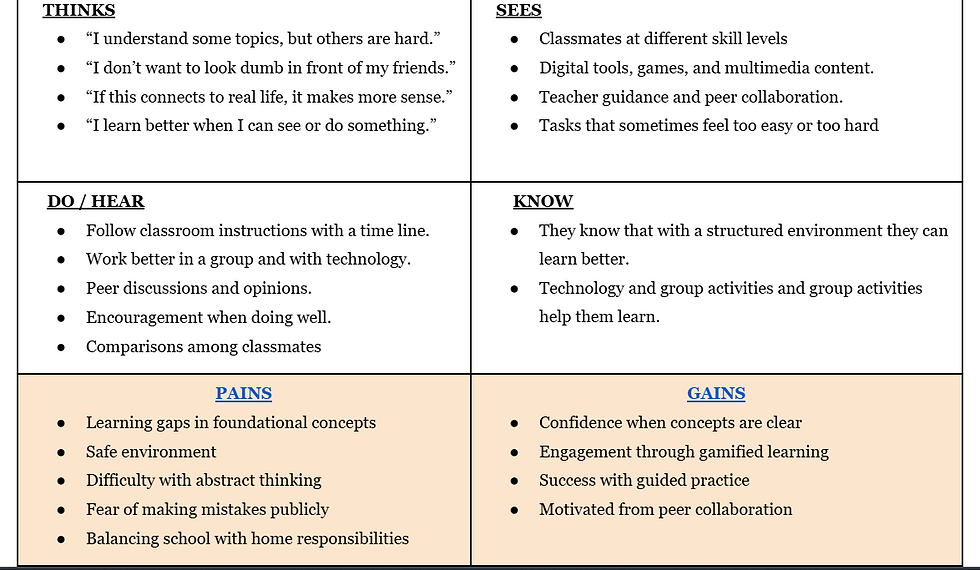
Developed empathy maps and learner personas (view).
-
Derived instructional design implications.
-
Defined the problem statement.
Phase 2: Analysis & Design
Focused on defining strategy, aligning learning outcomes, and structuring an effective learning experience.
-
Defined role and responsibilities as learning Experience designer.
-
Clearly defining learning goals and objectives (view).
-
Considered backward design (view) approach to align assessment and learning objectives.
-
Exploring solutions using divergent and convergent thinking for assessment design and lesson planning.
-
Selecting appropriate instructional strategies and learning principles and theories based on learner needs such as Gagné’s Nine Events and Bloom’s Taxonomy to plan lesson (view).
-
Selecting the primary learning platform.
-
Defining the solution and outcome.
Phase 3: Developement
Focused on translating design decisions into structured learning content and prototypes.
-
Designed complete lesson outline (view)
-
Created detailed storyboard (view)
-
Authoring view (view)
-
Developed mock-up slides (view)
-
AI was strategically leveraged to address stakeholder time and budget constraints by accelerating ideation for content, assessments, and learning activities, as well as refining instructional language. All AI-generated content was carefully reviewed and validated prior to implementation.
Phase 4: Implementation
Focused on testing, validating, and refining the learning experience before full implementation.
-
Conducted module implementation
-
Conducted pilot testing before full rollout.
-
Conducted small group pilot testing and technical testing.
-
Feedback collected on learner reaction, learning outcomes, and performance impact.
Phase 5: Evaluation & Revision
Focused on analyzing feedback and continuously improving the learning experience.
-
Identified key findings and areas for improvement.
-
Evaluated learner feedback (reaction) and assessed learning outcomes.
-
Analyzed impact on performance and effectiveness.
-
Developed a continuous improvement plan.
-
Both qualitative and quantitative data were reviewed to determine whether learning objectives were met and to identify areas for improvement.
-
Revisions to content clarity, instructional strategies, assessments, and pacing were made to ensure continuous improvement and stronger alignment with learner needs
Inside the Design Process- Project Deep Dive
The Learning Gap
At a Middle School, only 16% of 6th graders demonstrate proficiency in classifying renewable and non-renewable resources. This knowledge gap makes it difficult for students to engage in more complex environmental topics later in the unit.
Phase 1: Learner Research & Analysis
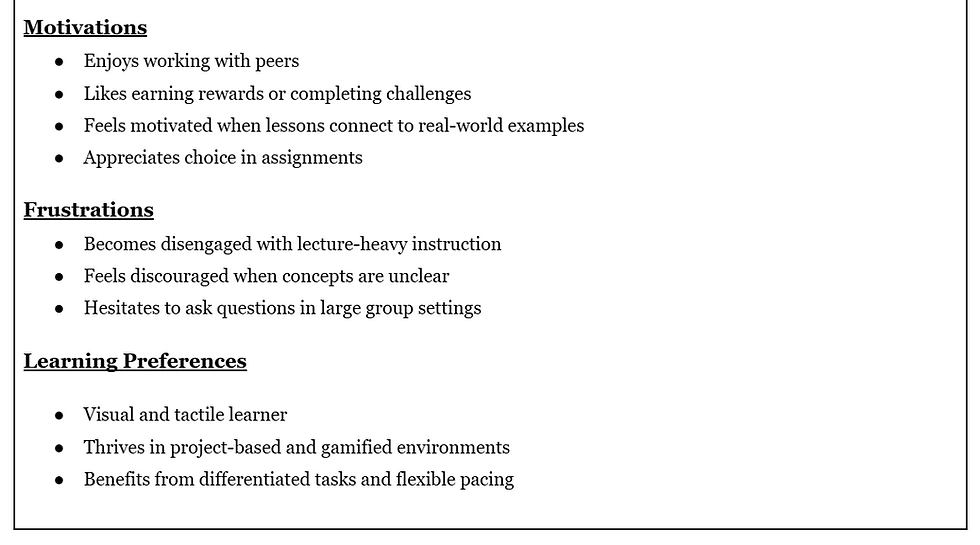
To better understand learner needs, classroom observations and students, teachers, Stakeholders and subject matter experts interviews were conducted. The findings informed the design of the e-learning module.
Learner's Prior Knowledge & Skills-
-
Students show varied levels of prior knowledge, particularly in Social Science.
-
Only a small percentage can accurately classify renewable and non-renewable resources.
-
Observation indicates a need to strengthen foundational concepts through differentiated instruction.
-
Learners are generally comfortable with technology and familiar with Canvas.
Learner's Age & Development-
-
Learners are 11–12 years old.
-
Benefit from structured guidance and scaffolded instruction.
-
Require opportunities for guided exploration and deeper understanding.
Learner's Academic Readiness-
-
Academic readiness varies across Grade 6 learners. Observations highlighted the need for:
-
Structured guidance
-
Guided practice before assessment
-
Multiple submission opportunities
-
-
Course design should incorporates:
-
Scaffolded learning, formative feedback before summative assessment, flexible learning pathways, inclusive assessment options.
-
Learner's Motivation & Challenges-
-
Learners are motivated by:
-
Real-life connections, choice, engaging and interactive formats in learning.
-
Engagement increases through:
-
Interactive games, digital storytelling, collaborative activities with peer.
-
Learners prefer active, hands-on, and creative learning experiences.
-
Many favor visual and peer-supported learning environments.
-
-
-
Key challenges identified:
-
Need for structured guidance and scaffolded support.
-
Varying levels of prior knowledge and confidence.
-
Flexibility is important, as some learners manage external responsibilities outside
-
the classroom.
Instructional & Contextual Constraints-
-
Identified constraints: limited time, limited resources, limited professional development.
-
Strong preference for using familiar tools (Canvas LMS) over new technologies.
-
Design decisions considered: Curriculum alignment, instructional strategies, digital readiness.
-
Ensured accessibility and inclusivity throughout the design.
Empathy Map and Persona
Defining the Problem Statement
Findings from observations and learner analysis identified a significant learning gap in Grade 6 Social Studies. At the middle school level, only 16% of students demonstrate proficiency in classifying renewable and non-renewable resources. This gap in foundational understanding limits students’ ability to engage with more complex environmental concepts and higher-order thinking tasks.
Defining My Role As Learning Experience Designer
Following the analysis conducted in Phase 1, Phase 2 focused on systematically transforming research findings and stakeholder constraints into an aligned instructional design plan.
In my role as a Learning Experience Designer, I operationalized the defined scope by aligning measurable learning objectives, assessment strategies, pedagogical frameworks, and technology integration. This phase ensured that the proposed solution directly addressed the identified knowledge gap while remaining feasible within institutional limitations.
Phase 2: Design Process
1. Translating Research into Design Priorities
-
Analyzed findings from learner research and stakeholder interviews.
-
Identified key insights:
-
Gaps in foundational knowledge
-
Varied academic readiness
-
Strong comfort with technology
-
Preference for interactive and collaborative learning
-
-
Considered stakeholder constraints:
-
Limited time and resources.
-
Minimal professional development capacity.
-
Preference for familiar platforms (Canvas LMS)
-
-
Established key design priorities:
-
Scaffolded learning
-
Engaging and interactive experiences
-
Inclusive design
-
Alignment with measurable outcomes.
-
Feasibility within existing system constraints
-
2. Backward Design as the Structural Foundation
-
Adopted a backward design approach to ensure alignment and clarity.
-
Defined the learning goal to address the identified proficiency gap.
-
Designed aligned assessments:
-
Formative quizzes
-
Guided classification activities
-
Summative project with student choice
-
-
Developed instructional activities to prepare learners for assessments
-
Ensured:
-
Clear learning progression
-
Alignment between objectives, instruction, and evaluation
-
3.The Learning Goal and Objectives
-
Learning Goal: By end of the course students will be able to identify and classify natural resources and apply their understanding through a real-world project with at least 80% accuracy.
-
Module 1(Day 1): By end of the module 1 students will be able to Identify and classify renewable and non-renewable natural resources (80% accuracy).
-
Module 2(Day 2): By end of the module 2 students will be able to Compare and contrast renewable vs. non-renewable resources (80% accuracy).
-
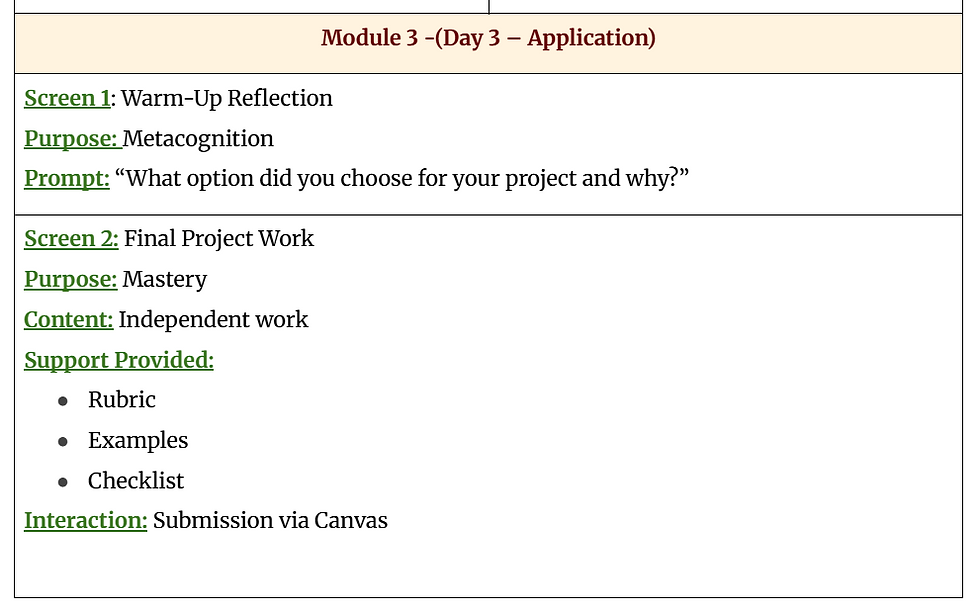
Module 3(Day 3): By end of the module 3 students will be able to Apply learning through a project to identify, classify, compare, and contrast resources using rubric guidelines (80% accuracy).
4. Ideation and Strategic Decision-Making
-
Used divergent thinking to explore multiple instructional strategies:
-
Simulations
-
Peer instruction
-
Gamified quizzes
-
Case studies
-
Multimedia integration
-
-
Applied convergent thinking to evaluate and refine ideas based on:
-
Alignment with learner needs
-
Feasibility within Canvas LMS
-
Time and resource constraints
-
Stakeholder preferences
-
-
Eliminated strategies requiring unfamiliar tools or extensive training
-
Prioritized high-impact, practical solutions using existing technology
-
Leveraged AI to:
-
Generate formative assessment ideas
-
Support content ideation across cognitive levels
-
Improve efficiency while maintaining quality
-
5. Platform Selection
-
Selected Canvas LMS as the primary platform because:
-
Students and teachers are already familiar with it
-
No additional training is required
-
Supports multimedia, assessment, collaboration, and feedback tools
-
Aligns with stakeholder preference for existing systems
-
-
Ensured smooth implementation and instructional flexibility
6.Pedagogical approach
-
Designed a structured, teacher-guided yet learner-centered approach
-
Grounded in constructivist principles:
-
Active learning
-
Collaboration
-
Real-world application
-
-
Addressed varied readiness levels through:
-
Scaffolded instruction
-
Guided practice
-
Gradual release of responsibility
-
-
Supported transition from:
-
Foundational understanding → independent application
-
7. Instructional Frameworks selections
-
Bloom’s Taxonomy supported progression from:
-
Identification and classification
-
To application, analysis, and creation
-
Aligned with learners’ transition to abstract thinking
-
-
Gagné’s Nine Events of Instruction guided lesson sequencing:
-
Attention → prior knowledge → guidance → practice → feedback
-
-
Universal Design for Learning (UDL) ensured:
-
Multiple means of representation (videos, readings, visuals)
-
Expression (choice in project formats)
-
Engagement (collaboration, real-world connections)
-
-
Accessibility Considerations:
-
Captioned videos
-
Mobile-friendly resources
-
Flexible submission options
-
Intuitive navigation
-
-
Ensured the module is: inclusive, developmentally appropriate, instructionally aligned
8. Digital Tools selection
-
Selected tools aligned with learner preferences and system constraints
-
Included:
-
Short educational videos → simplify abstract concepts
-
Real-world reading articles → build contextual understanding
-
Interactive Canvas practice slides → guided and independent learning
-
Formative quizzes → immediate feedback and mastery
-
Rubrics → clear expectations and structured feedback
-
-
Each tool directly supports:
-
Learning objectives
-
Conceptual understanding
-
9. Design Constraints and Considerations
-
Addressed key constraints:
-
Diverse readiness levels → scaffolded instruction and differentiated tasks
-
Cognitive load → progressive content sequencing
-
Engagement needs → gamification, collaboration, project-based learning
-
System limitations → reliance on Canvas LMS and familiar tools
-
10.Conclusion
-
Phase 2 focused on aligning:
-
Learner needs
-
Stakeholder constraints
-
Instructional strategies
-
Design frameworks
-
-
Applied:
-
Backward design
-
Learner-centered pedagogy
-
Structured progression
-
-
Resulted in an eLearning module that is:
-
Scaffolded
-
Engaging
-
Inclusive
-
Feasible within the school’s existing system
-
-
Directly addresses the identified learning gap while supporting deeper conceptual understanding
Proposed Solution
To address the learning gap, an engaging eLearning module was developed using existing Canvas LMS features. The course integrates interactive content, collaboration, guided practice, formative assessments, and timely feedback.
By leveraging familiar tools and brief tutorials without introducing new technologies the solution ensures effective instruction within practical constraints.
Phase 3: Development
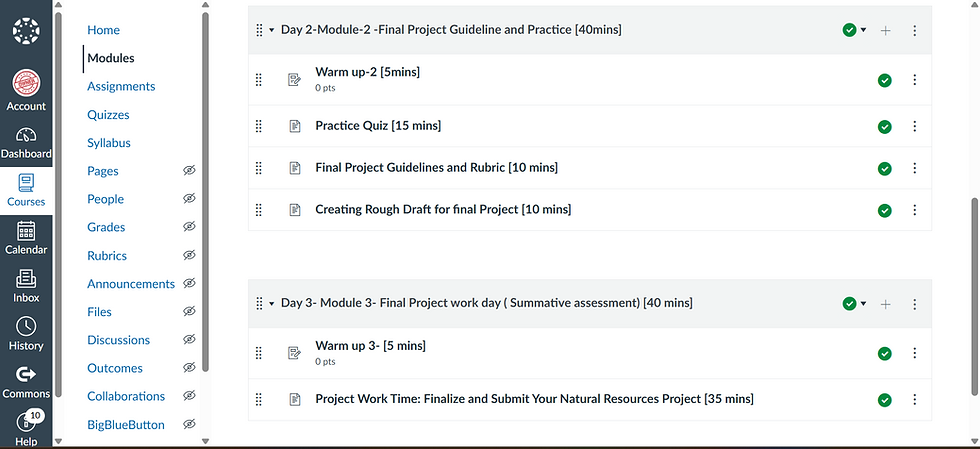
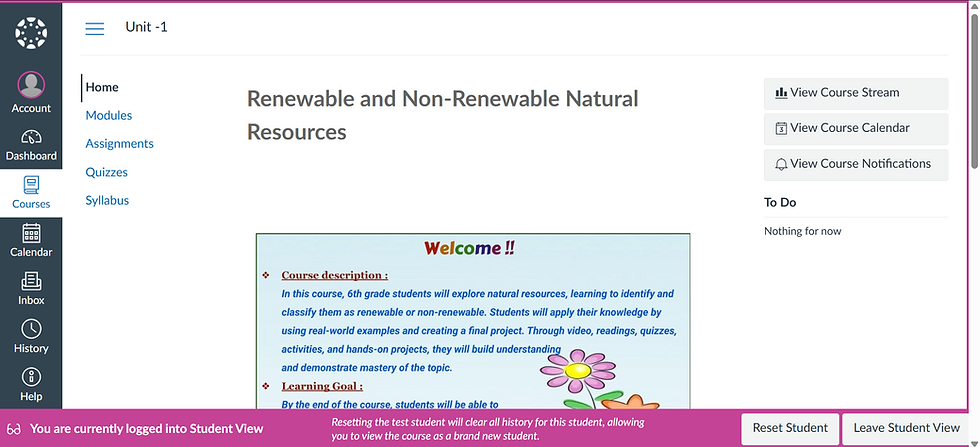
In Phase 2 (Design), instructional frameworks guided the alignment of learning objectives, assessments, and instructional strategies, ensuring all activities supported the intended outcomes. In Phase 3 (Development), these principles were implemented within Canvas through scaffolded lessons, multimedia elements, accessible content, embedded feedback, and differentiated projects. This structured approach ensured the final eLearning module was practical, inclusive, and closely aligned with learner needs.
Lesson outline


Story Board


Authoring View


Mock-Up (Student view)

Phase 4: Implementation & Data gathering
Following the completion of the prototype, the course was fully developed and implemented within Canvas LMS. The content was structured to ensure accessibility, proper citation, and a clear, sequential flow to support intuitive navigation and a cohesive learning experience.
Pilot Testing:
The course was pilot tested in a classroom setting with a group of learners representative of the target audience. These learners were already familiar with Canvas and comfortable using the required technology, allowing the focus to remain on the learning experience rather than tool adoption.
Delivering the course in its intended environment enabled observation of authentic learner interactions. Students accessed the module using standard technical requirements, including a reliable internet connection, updated web browsers, and multimedia capabilities.
This phase provided an opportunity to evaluate:
-
Clarity of instructions and navigation
-
Effectiveness of learning activities
-
Learner engagement and participation
Data Collection Approach:
To evaluate the effectiveness of the course design, both quantitative and qualitative data were collected to inform iterative improvements.
Quantitative data:
Quantitative measures focused on learner performance and engagement, including:
-
Pre- and post-assessment scores to measure learning gains
-
Rubric-based evaluation of final projects
-
Quiz performance and mastery levels
-
Completion rates and time-on-task analytics
-
Canvas engagement data (activity participation, submissions)
Qualitative data:
Qualitative insights were gathered to better understand the learner experience and usability of the course:
-
Open-ended student feedback and reflections
-
Usability and feedback sessions conducted during implementation
-
Instructor observations of learner interaction and collaboration
These insights helped identify patterns related to:
-
Ease of navigation within Canvas
-
Accessibility and clarity of content
-
Student confidence and engagement levels
Outcome of Data Analysis:
The combination of quantitative and qualitative data provided a comprehensive view of both learning outcomes and user experience. This analysis highlighted strengths in learner engagement and areas requiring refinement, particularly in navigation clarity and instructional scaffolding.
The findings directly informed data-driven revisions, ensuring that the course was optimized for effectiveness, usability, and alignment with learning objectives prior to full-scale implementation.
Phase 5: Evaluation & Revision
Following the first iteration and comprehensive data collection, the course findings were reviewed in collaboration with staff and key stakeholders. Together, we analyzed learner performance data, usability feedback, and overall course effectiveness to identify areas for improvement.
Key Findings from Data Analysis
Data analysis revealed several clear patterns:
-
A need for more authentic assessments to better evaluate higher-order thinking skills
-
Minor visual inconsistencies impacting navigation and user experience
-
Unclear expectations regarding required technology skills, affecting learner confidence
These insights informed targeted, evidence-based revisions aligned with quality standards.
1. Strengthening Authentic Assessments
The assessment strategy was enhanced to include:
-
Short-answer questions
-
Scenario-based prompts
-
Project-based tasks
These were integrated alongside existing multiple-choice quizzes to provide a more comprehensive evaluation approach.
Rationale:
The original assessments did not fully align with higher-order learning objectives such as describing, explaining, and applying concepts. These revisions improve the measurement of critical thinking and real-world application.
2. Improving Visual Consistency and Navigation
Course design was standardized by:
-
Applying a consistent color scheme
-
Adding clear titles and headings across all pages
Rationale:
Feedback indicated that inconsistencies in visual design and missing headings disrupted navigation. These updates enhance readability, accessibility, and overall user experience.
3. Clarifying Required Technology Skills
An introductory section was added to outline:
-
Required digital skills
-
Guidance on using Canvas and external tools
Rationale:
Learners expressed uncertainty about technology expectations. Providing clear guidance improves accessibility and supports successful course completion.
4. Incorporating Formative Rough Draft Feedback
A structured opportunity was introduced for learners to:
-
Submit a rough draft of their final project
-
Receive formative feedback before final submission
Rationale:
This addition supports mastery learning by offering timely, actionable feedback prior to grading. It strengthens alignment with higher learning objectives and enhances overall feedback effectiveness.
Conclusion
This study highlights the importance of systematic evaluation and iterative refinement in the design of effective e-learning experiences. Through structured feedback analysis and alignment with the E-Learning Experience Quality Standards Rubric, targeted improvements were implemented to enhance:
-
Content clarity
-
Instructional strategies
-
Assessment design
-
Pacing and overall usability
These refinements strengthened alignment between learning objectives, instructional delivery, and learner outcomes.
The integration of AI:
The integration of AI-supported tools enhanced the efficiency of the evaluation process by:
-
Organizing and synthesizing feedback
-
Identifying trends in assessment data
-
Supporting comparison between learner performance and intended outcomes. AI-assisted drafting and refinement enabled timely improvements while maintaining instructional rigor and quality. All AI use aligned with ISTE Standards and institutional ethical guidelines, ensuring transparency, digital responsibility, and academic integrity.
Data Ethics and Responsibility:
Particular attention was given to data ethics throughout the process.
-
Data collection was limited to essential instructional metrics (assessment performance, engagement data, and voluntary feedback)
-
No personally identifiable student information was shared with AI tools or external platforms
-
All data were anonymized or aggregated, securely stored, and used solely for instructional improvement
Final interpretations remained grounded in professional judgment, ensuring that technology functioned as a support tool rather than a replacement for ethical educational practice.
Overall Impact:
Overall, this study reaffirms the value of responsive, evidence-based instructional design. The iterative cycle of implementation, feedback, and refinement resulted in a learning experience that is:
-
Pedagogically grounded
-
Practical and classroom-ready
-
Inclusive and accessible
-
Adaptable to authentic learning environments
Future Considerations:
Continuous evaluation, responsible data stewardship, and ethical integration of emerging technologies remain essential for sustaining meaningful and effective learning experiences.