.png)
Designing With Purpose

Live Course Access Link
NOTE: This course is hosted on SCORM Cloud to provide the full interactive experience (including audio and downloadable resources). You may be asked to enter a name and email to launch the module (any email and initials can be used i.e. hsohony02@gmail.com; H.S.)
Course Images and Video
Project Images Gallery


Video Walk Through

The Problem
Educators are encouraged to adopt AI, but concerns about ethical and responsible use often prevent them from doing so. This leads to low AI adoption and missed opportunities to improve teaching effectiveness and productivity. There is a need for practical, scenario-based learning that builds educators' confidence in using AI responsibly.

The Solution
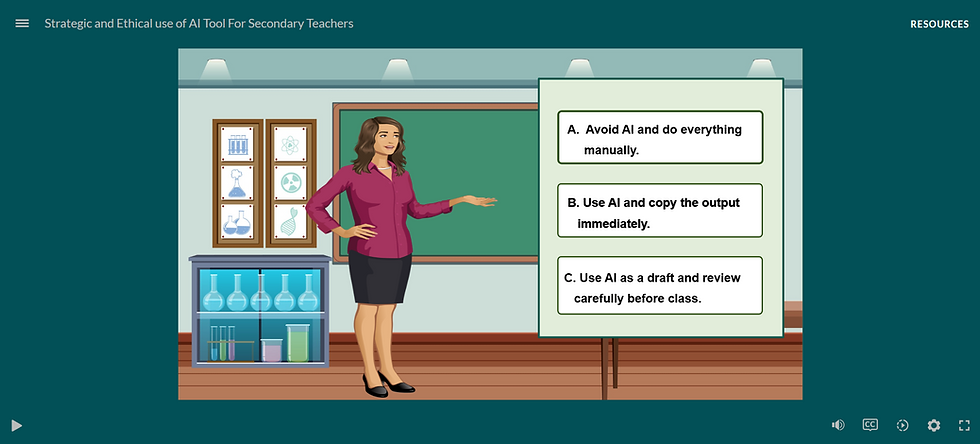
Designed and developed a self-paced, scenario-based eLearning course in Articulate Storyline 360 to help educators build confidence in using AI tools ethically and responsibly. Through realistic classroom scenarios, learners practice making informed decisions, reinforcing best practices while addressing concerns around ethics, accuracy, and professional responsibility.

The Outcome
The course increased educators' confidence in using AI responsibly by providing practical, scenario-based guidance for real classroom situations. By addressing common misconceptions and ethical considerations, it empowered learners to make informed decisions and integrate AI into their teaching workflows with greater confidence.

Deep Dive into the Design Process
Learner's Analysis

Research Methods

Classroom Observation & Contextual Research

Stakeholder & Subject Matter Expert (SME) Consultations

Learner Interviews

Understanding & Identifying Learner Motivations & Challenges
Key Findings From Research
Learning Context
-
Experienced educators
-
Regular users of digital tools & online platforms
-
Varying levels of digital confidence
-
Open to learning new teaching technologies.
Need for Support
-
Clear guidance and examples
-
Practical classroom strategies
-
Step-by-step implementation support
-
Easy integration into existing workflows
Knowledge Gaps
-
Limited practical AI application
-
Uncertainty about AI benefits and limitations
-
Concerns about responsible AI use
-
Need for greater AI confidence
Motivation Factors
-
Save time in planning and assessment
-
Improve productivity and teaching effectiveness
-
Real classroom examples and activities
-
Ethical AI checklist and guidelines
Instructional Design Artifacts
Created an empathy map and learner personas to better understand the target audience's needs, challenges, motivations, and goals. These insights guided design decisions and ensured the course addressed real classroom needs.


Research Insights & Problem Statement
Learner research revealed differences in teachers’ AI familiarity and digital confidence. While teachers were motivated to save time and improve efficiency, they needed practical guidance, ethical AI support, and structured strategies for classroom application.
My Role & Proposed Solution
As the Instructional Designer, I synthesized research findings into learner-centered design decisions. I developed a practical, scenario-based learning experience that provided step-by-step guidance, real classroom examples, and frameworks for responsible AI use.
SME Collaboration & Design Transition
I partnered with subject matter experts to validate content accuracy, ethical considerations, and classroom relevance. Their feedback helped refine the learning experience and informed the transition from analysis to design and development.
Design
Design Goal
Create a learner-centered course that helps secondary school teachers confidently and responsibly integrate AI into their teaching practice.
Design Decisions
Research findings informed the following design choices:
-
Selected Articulate Storyline 360 as the primary development tool for creating learner-controlled, branching scenarios and interactive learning experiences.
-
Applied andragogy principles to support adult learners through relevant, self-directed learning.
-
Incorporated microlearning to accommodate busy teachers' schedules.
-
Used scenario-based learning to connect course content to real-world classroom situations.
-
Included worked examples and guided practice to reinforce learning through application.
-
Added formative assessments with immediate feedback to help learners check their understanding.
-
Provided AI ethics checklists pdf as practical job aids resource for future reference.
-
Followed accessibility and inclusive design principles to create an experience that supports diverse learners.
Instructional Design Artifacts
To ensure the course was instructionally sound, I documented the lesson outline, learning theories, and storyboard before development. These artifacts helped align learning goals, instructional strategies, assessments, interactions, and course flow, ensuring every design decision supported the desired learning outcomes.


Branching Sceneraio Plan


Development
The storyboard and visual design were translated into an interactive eLearning prototype using Articulate Storyline 360. Learner interactions, assessments, multimedia elements, and supporting resources were developed to support the intended learning experience.


Implementation & Data Gathering
Purpose and Planning of Usability Test & Methodology
The purpose of usability testing would be to evaluate whether educators can successfully navigate the course, engage with interactive activities, apply ethical AI concepts, and access supporting resources independently. The evaluation would focus on identifying navigation challenges, content clarity issues, and opportunities to improve the overall learning experience before broader implementation.
Preparing and planning usability test
A pilot implementation would be conducted using a small group of representative learners. Participants would complete the course independently while providing feedback on usability, content relevance, interaction design, and overall course effectiveness. Observations and learner feedback would be used to identify areas for refinement.
Participants, Setting and Equipments
Participants would consist of K–12 educators and instructional professionals who represent the intended audience. Testing would be conducted remotely using a computer or laptop with internet access. Learners would access the course through a learning management system (LMS) or web-based environment and complete the activities independently.
Roles in Usability Tests
The instructional designer would facilitate the testing process, observe learner interactions, and document feedback. Participants would complete course activities, knowledge checks, and the feedback survey while sharing observations regarding navigation, content clarity, and usability.
Reflection on Data Collection
The planned usability testing would provide insights into learner navigation, engagement, content clarity, and overall course effectiveness. Feedback gathered from participants would help identify opportunities to improve interactions, streamline navigation, and enhance learner support. These findings would inform future revisions and ensure the course remains aligned with its learning objectives and intended learner experience.
Evaluation & Course Revision
The purpose of evaluation would be to analyze usability testing feedback and determine how effectively the course supports its learning objectives. Findings would be reviewed to identify opportunities to improve navigation, content clarity, learner engagement, and interaction design.
Based on the evaluation results, revisions would focus on refining course instructions, enhancing learner support, improving accessibility, and strengthening interactive activities. This iterative process would help ensure the course provides an effective, engaging, and learner-centered experience.
Conclusion
This case study demonstrates the complete instructional design process used to create a scenario-based microlearning course on ethical AI use in K–12 education. The project illustrates how instructional design principles, interactive learning strategies, and eLearning technologies can be combined to support meaningful and practical learning outcomes.